
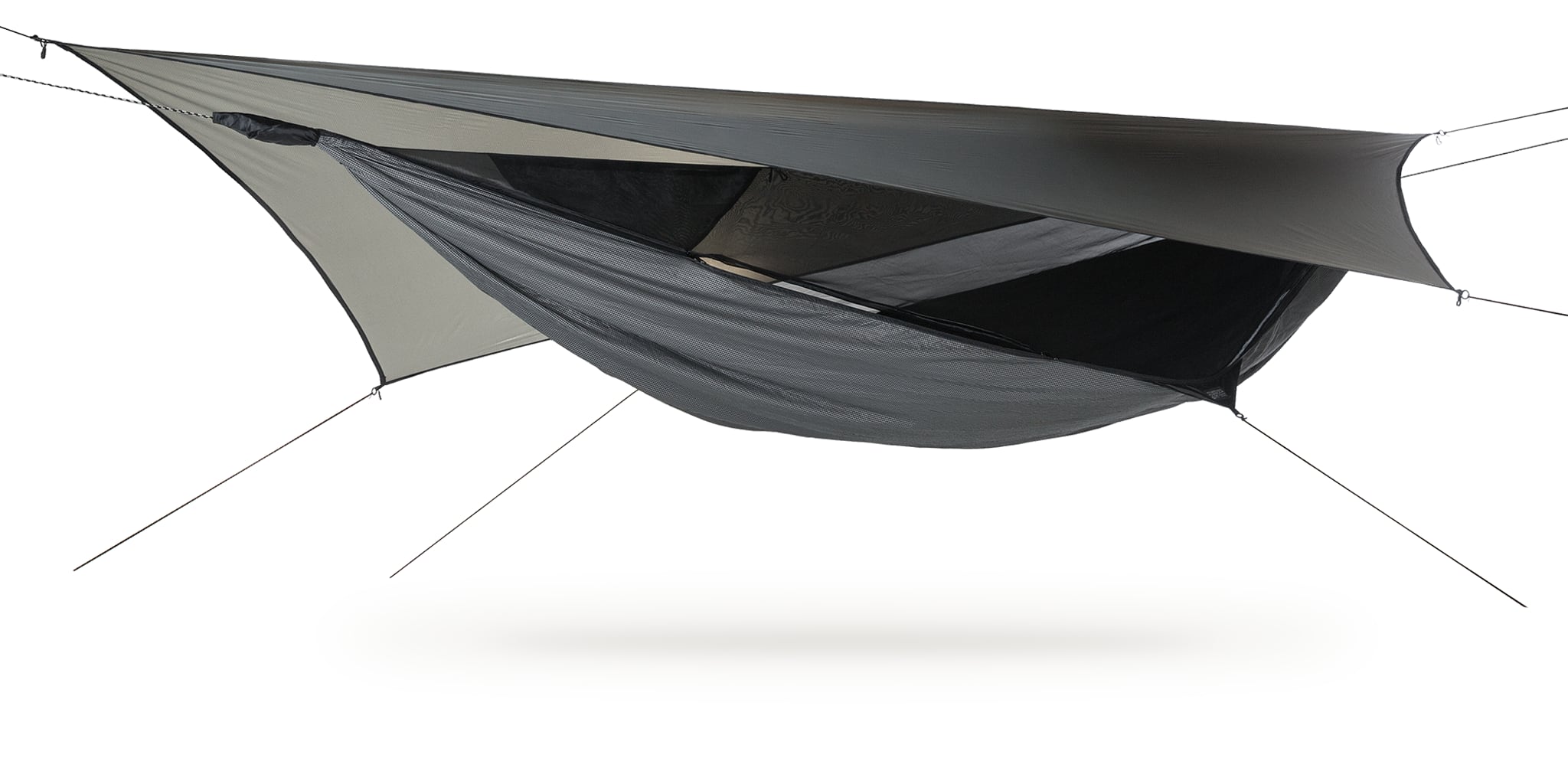
Your needs, this model
Does it fit your priorities?
Is the M240 stock offer insect screened and does it include tree webbing?
The exact M240 page lists 20D polyester No-See-Um mesh and says the standard hammock comes with attached mosquito netting; it also specifies complimentary 42-inch TreeHugger webbing. Confirm the final M240 package and current instructions before ordering.
Explore this need in the finder →How does the standard M240 differ from the custom Deep Jungle Zip XL body listing?
M240 is the standard-rainfly package with stock 42-inch webbing. Product 306421699 starts without a rainfly and lets the buyer select 42-, 72- or 96-inch TreeHugger webbing, with weather and insulation choices shown separately. Match the product ID and line items, not only the shared Deep Jungle XL name.
Explore this need in the finder →Does its published body spec clear a 10.5-foot, 59-inch, 300-pound request?
The M240 page lists 130 by 59 inches, a 7-foot height limit and a 300-pound hammock limit. That clears those numeric filters in the finder, but neither length nor width predicts individual comfort, and the capacity does not rate the complete hanging system.
Explore this need in the finder →This is a source-based assessment of the U.S. Hennessy Hammock Deep Jungle Zip XL, standard SKU M240. I have not owned, camped in, measured, or load-tested it; the judgments below come from the exact manufacturer page, its public product record, and the maker's comparison chart. The key buying distinction is easy to miss: M240 is the stock-rainfly package, while a separate “Customize your Deep Jungle Zip XL” listing starts with the body and selected webbing but no fly.
What the standard M240 actually includes
Hennessy describes the M240 as a two-layer-bottom, side-zip hammock with attached mosquito mesh, support ropes, compression sack, setup instructions and a detachable stock rainfly. Its page also specifies standard 42-inch TreeHugger webbing. That is a more complete starting package than the custom body listing, but it is still not an all-conditions sleep system: the under-body pad is a separate accessory, and the maker says the matching reflective pad attaches between the two bottom layers. A buyer planning a cold night needs to plan insulation, not infer that a double bottom itself is a temperature rating.
The large-side-entry layout is a functional advantage if a zipper is the preferred way to enter, but do not overread the manufacturer's “100% mosquito-proof” phrase as a guarantee against every insect, gap, campsite or setup error. The exact page describes the mesh as 20D polyester No-See-Um. The zipper detail itself is inconsistent: its description calls the zipper #8 while the specification line says #5. I would not use the gauge as a differentiating fact until Hennessy resolves that discrepancy.
XL dimensions are screening figures, not a fit promise
The model page lists 130 by 59 inches of lower fabric, a seven-foot manufacturer height limit and a 300-pound hammock weight limit. Dividing the 130-inch body length by 12 gives 10 feet 10 inches, or about 10.83 feet. That is the fabric measurement—not the distance between trees, room needed for the hang, or usable diagonal sleeping length. Likewise, 59 inches is listed fabric width, not a guarantee that a particular person will like the lay. The 300-pound figure belongs to the hammock body and must not be treated as a rating for the ropes, webbing, carabiners, anchors, trees or complete load path.
The smaller Deep Jungle Zip uses a 120-by-59-inch body and a 250-pound limit, while the XL is 130 by 59 inches and 300 pounds. That is a real model distinction, not a color option. It helps separate documented size tiers, but the numbers alone cannot choose a comfortable hammock for a specific sleeper. Read the manufacturer's instructions, and if the available span, anchor type or user requirements are unusual, get model-specific advice rather than extrapolating from the dimensions.
Rain, insulation and a full setup
The M240's stock rainfly gives it an overhead shelter layer that the first custom-builder step lacks. The page lists a parallelogram fly with sides of 70 and 110 inches and diagonals of 128 and 140 inches. Those are product dimensions, not a promise that the fly will cover every wind direction or campsite. Choose a site where the intended anchors and clearances are permitted; set and tension the fly using the current instructions; inspect the fabric and attachment points; and plan for wind-driven rain rather than assuming a hammock fly works like an enclosed tent.
Hennessy lists the reflective double-bubble pad XL as an accessory for the two-layer body, not as included insulation. The model description itself warns that jungle locations can become cold at altitude and identifies the hammock as a three-season design. That is a useful limitation: mesh and double fabric do not replace a forecast-based under-body insulation plan, and this review does not assign a temperature range. The product page also recommends a separate four-season system or an insulated model for a true four-season insulation system.
Package mass and source conflicts
Hennessy's listed packed weight is 3 pounds 2 ounces before the separately weighed 4 ounces of free webbing. The figure is the maker's claim, not an independent measurement; it also is not stated as a total mass for every piece a shopper may add. I have not added the strap figure to create a supposed package total. The public product record contains a weight number but no unit or contents basis, so it is not used to repair that ambiguity.
There is a second conflict worth keeping visible. The exact M240 page says the supplied Spectra ropes are tested to 1,500 pounds, while the comparison chart gives 1,800 pounds for Deep Jungle XL. Neither number is the hammock's body limit, and neither should be treated as a rating for the complete setup. Verify the current line items and exact instructions. A strong component number does not validate a different component or an improvised anchor.
Who should compare it with the custom listing?
Choose the ordinary M240 listing only if its stock package is the one you mean: it comes with the stock rainfly and standard webbing. The custom XL offer gives a choice of 42-, 72- or 96-inch webbing paired by Hennessy with tree diameters up to 14, 24 or 36 inches, but its first step explicitly orders the body without a rainfly. It offers fly and insulation options later. Check the product ID and final cart before treating the two listings as interchangeable. The custom image shows a branded sack and folded webbing, not the deployed hammock or chosen length; the standard M240 page image is the better visual reference for the stock-fly configuration.
This is therefore a documented XL, double-bottom and stock-shelter candidate, not a universal recommendation. Its attraction is the screen plus supplied fly and a clearly defined XL body; its costs are bulk, a separate insulation decision, unresolved component specifications and a need to verify the exact support system. No user experience, recall clearance or hands-on performance claim is implied.
Key specifications
Key details at a glance
| Hammock body length | 10.83 ft |
|---|---|
| Hammock body width | 59 in |
| Manufacturer-listed capacity | 300 lb |
| Listed hammock weight | 50 oz |
| Integrated bug net | Yes |
| Tree straps in this package | Yes |
Use the exact model’s instructions for operating limits, supplied equipment and version differences.
Sources for this review
Sources for this assessment
Compare this hammock with your actual setup
Check the hang, protection and package details before deciding whether it belongs on your shortlist.