
Your needs, this model
Does it fit your priorities?
Can Sunda 2.0 be used where there are no suitable trees?
Yes, the exact Kammok listing describes a ground-tent mode with two-person capacity and lists the frame poles, footprint, six stakes and guy-out cords. The hammock mode is a separate one-person sleeping arrangement, not the two-person tent configuration.
Explore this need in the finder →Is its supplied enclosure enough for bugs, rain and cold?
Kammok lists mesh walls and an attached rainfly, but no underbody insulation. The page calls Sunda 2.0 a three-season tent, says its mesh favors airflow, gives no temperature rating and says it is not intended for multi-day snow use. Plan insulation separately for cold conditions.
Explore this need in the finder →What must be checked before hanging Sunda 2.0?
The package lists two Python 10 straps and two carabiners, but no trees or anchors. Kammok's linked instructions specify suitable supports 13–18 feet apart, straps 5–7 feet above ground, a 30–40 degree strap angle and no more than 18 inches of hammock height. Follow the current instructions, inspect the gear and assess the actual site; the 400-pound hammock limit is not a rating for the whole hanging system.
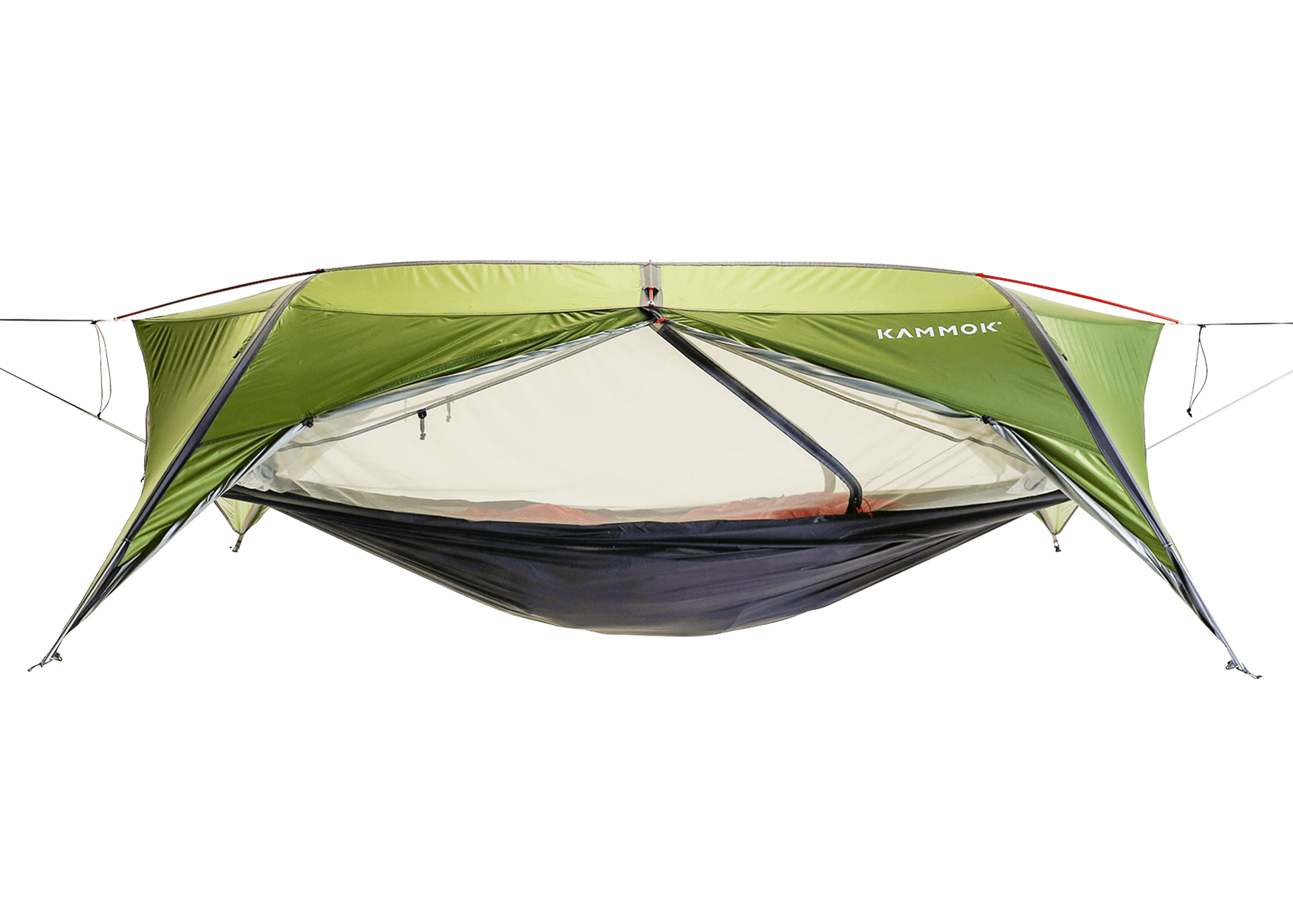
Explore this need in the finder →Kammok's Sunda 2.0 listing describes more than an open hammock with a tent tarp added: the same 40D floor/body, mesh walls, attached rainfly and frame turn into either an enclosed ground tent or a suspended hammock shelter. That two-place design is its defining advantage, but also the reason the packed package is much heavier and more involved than a hammock body. This assessment is source-based, not personal use or independent testing.
One shell, two very different sleeping plans
The maker lists a 100-by-50-inch floor/body and a 112-inch ridgeline. In ground-tent mode Kammok gives the shelter a two-person capacity; in hammock mode it says one person is the better fit. The page allows that two could sleep suspended if their combined load is below the 400-pound maximum, but explicitly says that arrangement is not ideal. Read the listed tent capacity as a ground-mode figure, not as a claim that this is a comfortable two-person hammock.
At 100 by 50 inches, the hammock body is 8 feet 4 inches long and 50 inches wide; neither number predicts fit. Kammok says the hammock body is the same size as its Roo Single, but Sunda uses coated fabric inside an enclosed, pole-supported shelter. Its 34.7-square-foot ground floor is not hammock-mode sleep space.
What the package replaces—and what it asks you to carry
Kammok lists an attached rainfly, four color-coded poles, footprint, two Python 10 straps, two carabiners, six stakes, six adjustable guy-out cords and a main stuff sack. The 15D mesh wall is integrated; there is no separate bug net to pitch. The package is more complete than an open hammock, but its weight is not: the maker gives 4 pounds 3.5 ounces as trail weight and 6 pounds 2.5 ounces total packed. These are different package bases, not body-only or independent weights.
The floor and hammock body are listed as 40D ripstop nylon with a 2000 mm PU treatment and DWR; the attached 20D polyester Lumos fly is listed with a 1200 mm PU coating. The product copy describes a waterproof bathtub floor, taped seams and rain protection. That integrated cover is convenient when one shelter needs to work on ground and in trees, yet Kammok says hammock mode requires the fly and pole structure to remain in place. It is therefore not the light open-hammock setup you would get by leaving a separate tarp behind. The included-insulation list is empty: a screen and overhead fly do not block the cold flowing beneath a suspended body.
Weather limits are more important than the word “all-weather”
Kammok calls this a three-season system, gives the mesh walls an airflow role and says the tent is not designed for multi-day use in snowy conditions. It publishes no temperature rating. Its FAQ also says wind-stability testing for the 2.0 is in progress. The same passage mentions a 25 mph result for the original Sunda, but that is not a Sunda 2.0 rating, so it should not be carried over. In a site or forecast where wind or temperature performance is an essential safety condition, treat the missing 2.0 result as unknown and consult current manufacturer guidance; do not use the old model's figure as a substitute.
For cold nights, the page says Kammok's Firebelly and Bobcat Trail Quilts can attach using the side loops. That does not mean an underquilt is included, nor does it make the shelter warm by itself. Match insulation to the whole sleep system and expected conditions.
Hammock mode still needs a suitable, careful hang
The supplied Python 10 straps and carabiners help, but the campsite supplies the supports. Kammok's linked Sunda setup instructions specify trees 13 to 18 feet apart, strap height of 5 to 7 feet, and a 30-to-40-degree strap angle. They cap hammock height at 18 inches, require inspection before each use and call for testing the elevated setup before loading. These limits do not certify any actual site. The 400-pound hammock figure does not rate the straps, carabiners, trees, poles or complete hang.
The product list and setup sheet use slightly different names for the included carabiners—“Mini Kanda Claw” on the page and “Kanga Claw” in the manual. Both say two are supplied; if a replacement or compatibility purchase depends on that name, confirm the hardware in the exact offer.
Who should put Sunda 2.0 on a shortlist?
It has a narrow but clear use case: a buyer who values one enclosed shelter that can be a two-person ground tent on a treeless pitch or a screened, one-sleeper hammock when appropriate supports are available. The included floor, poles, fly, insect-screen walls and straps reduce the number of separate components to plan. The costs are a nearly six-pound packed system, an 8-foot-4-inch hammock body, one-person hammock-mode sleeping, a fixed pole-and-fly arrangement and no included underbody insulation.
Choose an open hammock such as the Kammok Roo Single if you specifically want a lighter, simpler hanging body and are prepared to assemble net, rain cover, tree straps and warmth around it. Compare with the Mantis family if a dedicated hanging shelter is more important than Sunda's ground-tent option; the exact Mantis variants have different body materials, limits and package weights, so those details should be compared separately. Sunda's main advantage is the ground-to-air conversion, not a claim that it wins the weight, length or simplicity comparison.
Before buying, verify the exact product is Sunda 2.0 / product ID 9417427463, check the current Arbor Green or other selected offer and its contents, and review the linked setup sheet. Confirm its 100-by-50-inch body, 400-pound maker-listed hammock maximum and the mode-specific occupant limits suit your plan. If an exact wind rating, two-person hammock sleep, insulation, or a body longer or wider than the published dimensions is essential, this record does not establish it. Images depict the exact Arbor Green hammock-tent model in hammock mode; they do not prove a particular seller's package or personal performance.
Key specifications
Key details at a glance
| Hammock body length | 8.33 ft |
|---|---|
| Hammock body width | 50 in |
| Manufacturer-listed capacity | 400 lb |
| Listed package weight | 98.5 oz |
| Integrated bug net | Yes |
| Tree straps in this package | Yes |
Use the exact model’s instructions for operating limits, supplied equipment and version differences.
Sources for this review
Sources for this assessment
Compare this hammock with your actual setup
Check the hang, protection and package details before deciding whether it belongs on your shortlist.